The awkward part of charging for poop scooping usually is not entering a card number. It is explaining why the invoice says something different from what the customer thought they bought.
Was the price per visit or per month? Was the first cleanup included? Does a month with five service days cost more? When does the recurring charge start?
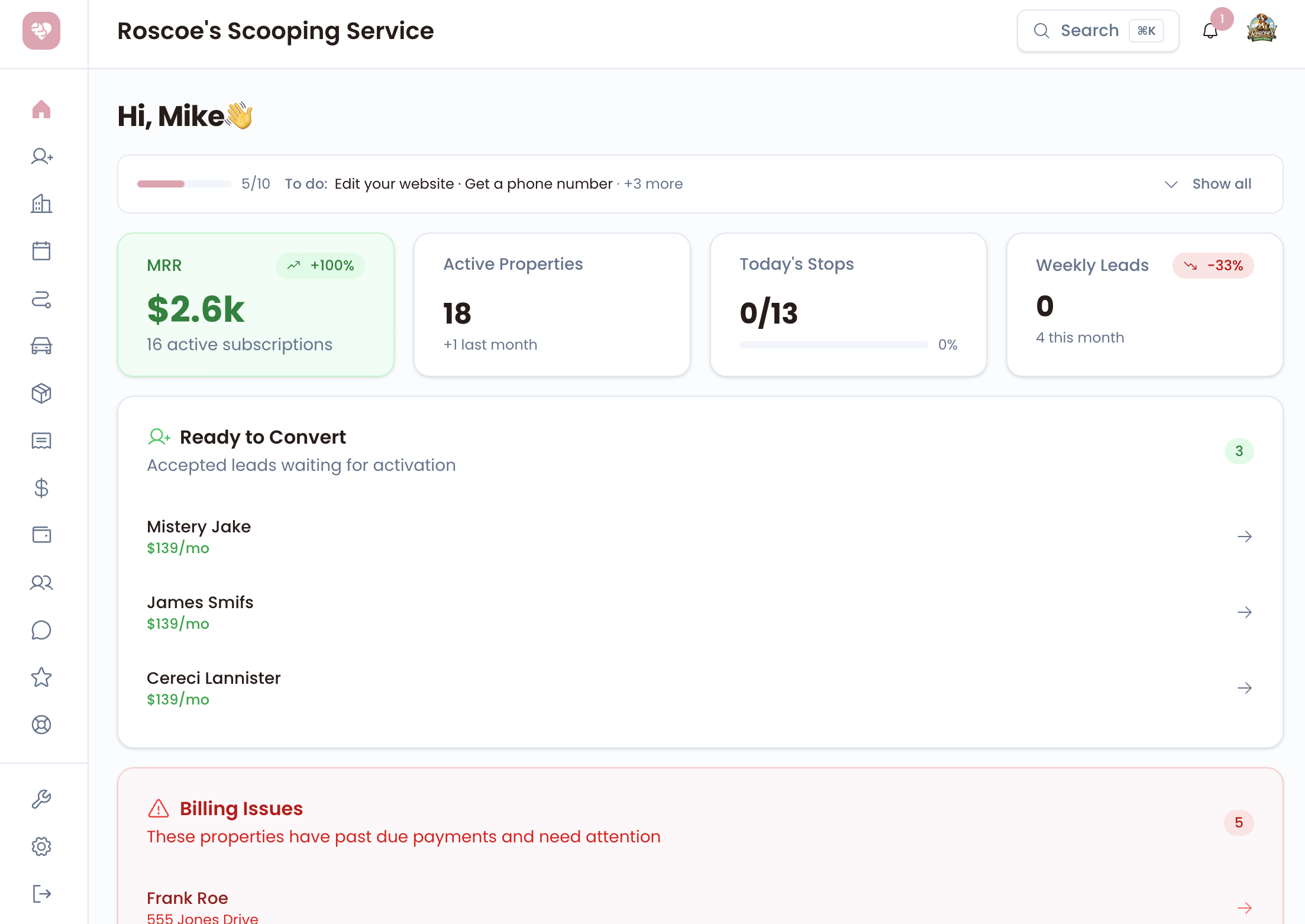
Answer those questions before you collect payment. You can start with a written agreement, invoices, and a calendar. Once you are managing recurring customers, putting the service and the billing in the same system saves a lot of checking one list against another.
Decide what your price actually buys
Pick a billing basis and describe it plainly. Per-visit billing charges for the applicable visits under your agreement. A fixed monthly plan charges a stated amount for the recurring service arrangement. Neither description should leave the customer guessing about what happens in a five-visit month.
If you advertise weekly service at $25 per visit, four visits add up to $100 and five add up to $125. If instead you spread fifty-two $25 visits across twelve equal monthly payments, the arithmetic is about $108.33 per month. That second figure is an annualized illustration, not a recommendation to promise exactly fifty-two visits regardless of your holiday, weather, or cancellation policy.
Those are three different statements. Do not write "$100 monthly" in the quote and then quietly switch to per-visit billing when a fifth service day comes around.
> In Scoopify: You can manage recurring service subscriptions and customer billing together. Decide the agreement first, then configure the recurring amount and billing schedule to match it. Software should carry out the offer you made, not invent one for you.
Separate the initial cleanup from ongoing service
A neglected yard can take much longer than a maintained weekly stop. Quote that initial work explicitly rather than hiding the cost inside a recurring rate that will be hard to explain later.
For example, your quote might state an $85 initial cleanup followed by a $100 monthly plan. Those are illustrative numbers only. The useful part is showing two distinct charges, the service each covers, and when each is due.
Confirm what happens if the yard condition differs materially from the information provided. A photo or a short qualification question can help. Do not arrive, complete substantially more work than agreed, and surprise the customer with an unapproved bill.
Use the [initial cleanup guide](/blog/how-to-price-an-initial-poop-scooping-cleanup) to build the quote. Include the amount and timing in the confirmation rather than relying on a conversation that only one person remembers.
Write the billing terms people actually ask about
You do not need a page of clever phrasing. You need a clear answer to each of these questions:
- What service frequency is included, and which property is covered?
- What is charged for the first cleanup?
- What is the recurring amount, and when does it start?
- When will later payments be collected?
- How do skipped visits, weather, holidays, access problems, and cancellations affect charges?
- Which extras require approval before being added?
Make the terms easy to find before the customer agrees. Rules vary by location and payment method, so have an appropriate professional review your terms and authorization language rather than treating a blog example as legal advice.
For your own planning, include travel, disposal, supplies, labor, software, and processing costs in the economics. The [pricing calculator](/tools/pricing-calculator) is a starting point for the numbers, not a substitute for tracking what your routes actually cost.
Collect authorization without collecting card details yourself
Use your payment provider's hosted or secure payment flow. Do not ask a customer to text you a card number, put card details in a property note, or store them in a spreadsheet.
Tell the customer whether the authorization covers one payment, recurring payments, or both. Make the amount and timing clear. Keep a record of the agreement and a reliable way for the customer to ask about a charge or update payment information.
> In Scoopify: Billing runs through Stripe-powered payment flows. Initial cleans, recurring subscriptions, invoices, and payment history can stay connected to the customer record. Stripe processing fees remain separate from any Scoopify subscription or platform fee. See [billing features](/features#billing) and [current plan pricing](/pricing).
Choose the recurring start date deliberately
The date a customer submits a quote request is not necessarily the date recurring service starts. A first cleanup might happen this Thursday, while the regular route day begins the following Tuesday.
Write out that example before configuring it. Which payment covers Thursday? What starts Tuesday? Is the next recurring invoice a full cycle or an adjustment? Check the configuration against the written offer before activating the subscription.
If you use proration, verify the actual invoice preview rather than guessing that a partial month will be calculated the way you imagined. Your chosen billing setup determines the charge; marking a service visit complete is not a blanket instruction to charge a card immediately.
Make failed payments a workflow, not a personal chase
A declined card does not automatically mean a customer refuses to pay. Cards expire, banks decline transactions, and customers change payment methods.
Use the payment provider's available retry and notification tools as appropriate, and have a written follow-up process. Check the payment status first. Ask the customer to update their method through a secure link. Escalate or pause service according to your agreement rather than making a different decision every time.
Before manually collecting an outstanding balance, check whether another attempt is already scheduled. Charging twice creates a bigger support problem than the original decline.
Scoopify keeps billing information alongside the service relationship so you can check what happened without piecing it together from a bank statement and a notebook. Two-way SMS and advanced automated outreach currently require Pro; core recurring billing does not. Do not confuse those plan boundaries when choosing your setup.
Reconcile the work, the invoice, and the payout
These are different records. A completed visit shows work was recorded. An invoice shows an amount billed. A successful payment shows a collection. A payout shows money moving from the processor to your bank, with timing and eligibility set by Stripe.
Check those records regularly, especially after changing a plan, adding a charge, or resolving a failed payment. Keep processing fees and software charges separate in your bookkeeping so a net bank deposit does not become your only record of revenue.
For a small operation, a consistent manual review may be enough. As the customer list grows, [Scoopify's customer and billing tools](/features#customers) help keep the details together. The point is not to automate an unclear agreement. It is to make a clear agreement repeat reliably.